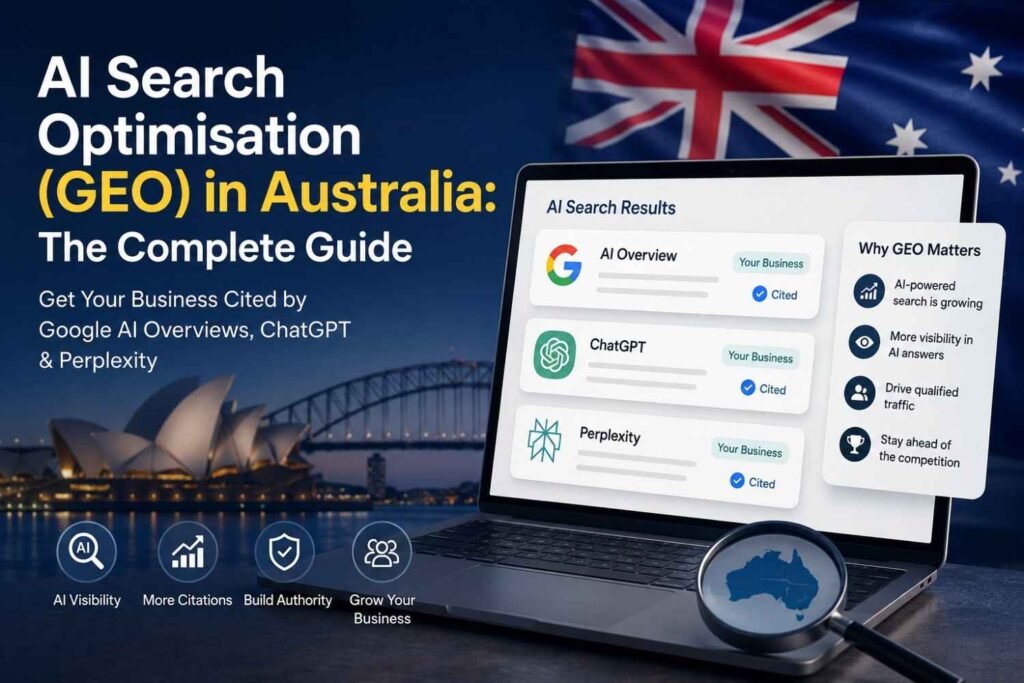
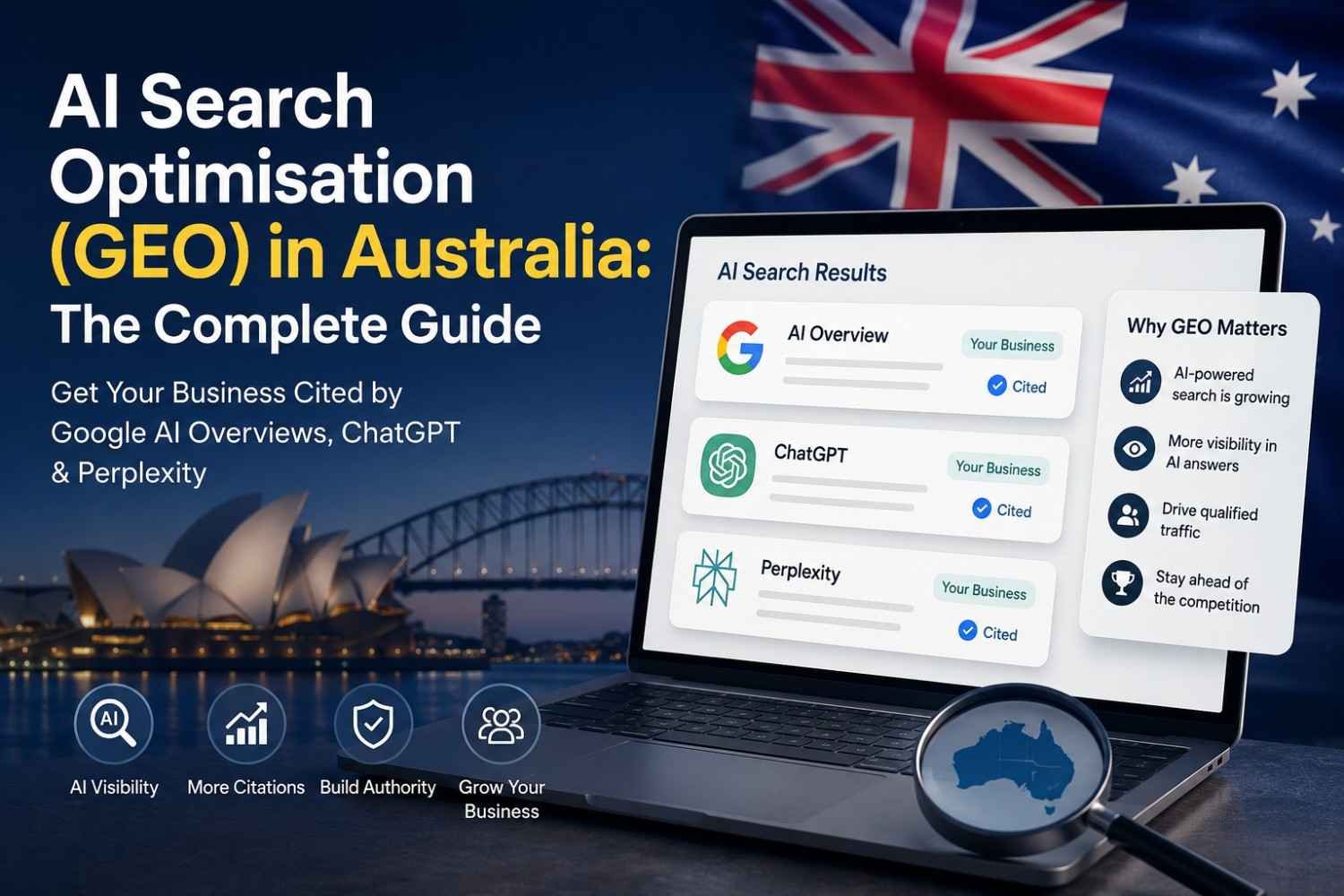
AI Search Optimisation (GEO) in Australia is the future of digital visibility, helping businesses earn trusted AI citations and reach more potential customers. Australian customers are no longer just Googling and scrolling through ten blue links they’re asking Google’s AI Overviews, ChatGPT and Perplexity for a straight answer, and a growing share of them stop right there. AI search optimisation, often called GEO (Generative Engine Optimisation), is the practice of structuring your website and content so those AI systems can find you, trust you, and name you as the answer. This guide covers what GEO actually involves, how it’s different from (and connected to) traditional SEO, and the specific steps Australian businesses can take to start showing up in AI-generated answers.
Table of contents
- What is AI search optimisation (GEO)?
- GEO vs SEO vs AEO: what’s the difference?
- Why this matters for Australian businesses right now
- How Google AI Overviews, ChatGPT and Perplexity actually choose what to cite
- The 7 things that move the needle for GEO
- A practical first-90-days GEO checklist Common GEO mistakes to avoid FAQs
What is AI search optimisation (GEO)?
AI search optimisation (GEO) is the process of structuring a website’s content, data, and technical setup so that AI-powered search tools Google AI Overviews, Google AI Mode, ChatGPT, Perplexity, Claude and Gemini can extract your content and cite your business directly inside their generated answers. Instead of ranking a webpage in a results list, GEO aims to get your business mentioned, quoted, or recommended in the actual answer a customer reads. Google has stated plainly that this isn’t a separate channel bolted onto search it’s an extension of it. Optimising for AI Overviews and AI Mode is still fundamentally SEO, built on the same foundations of quality content, technical health, and trust signals. What’s changed is that the finish line has moved. Ranking on page one used to be the goal. Now,being the source an AI system chooses to quote is the goal and ranking on page one is simply the entry ticket to be considered.
GEO vs SEO vs AEO: what’s the difference?
These terms get used interchangeably, but they describe slightly different layers of the same discipline:
- SEO (Search Engine Optimisation): getting your pages to rank in traditional search results — Google, Bing, and the organic listings underneath AI Overviews.
- AEO (Answer Engine Optimisation): structuring content so it can be extracted as a direct, standalone answer — the discipline behind featured snippets, “People Also Ask,” and AI-generated answer boxes.
- GEO (Generative Engine Optimisation): the broader practice of making your brand visible, trusted, and citable across generative AI platforms like ChatGPT, Perplexity, Gemini and Claude — including things AEO doesn’t cover, like brand mentions on third-party sites, entity recognition, and how AI models describe your business when no single page is being “cited” at all.
In practice, a good GEO strategy uses AEO techniques (structure, schema, direct answers) on top of solid SEO fundamentals (technical health, authority, relevance). You don’t need three separate strategies — you need one content approach built to satisfy all three at once.
Why this matters for Australian businesses right now
AI Overviews now appear on a substantial share of informational Google searches in Australia, and that share has grown quickly year on year. When an AI Overview appears above the organic results, click-through rates to the traditional #1 result can drop by roughly half — but businesses that get cited inside the AI Overview itself see a meaningful click-through boost compared to competitors who aren’t cited at all. In other words: the traffic hasn’t disappeared, it’s been redistributed toward whoever the AI decides to quote. The gatekeeping has also loosened in an important way. Where a business ranking on page one of Google used to have a strong claim on AI citations too, current research shows only a minority of AI citations now come from a page’s Google top-10 ranking — some studies put the overlap as low as 12–20% outside of Google’s own AI Overviews. Smaller, newer, or lesslinked Australian businesses that get their content structure right can out-cite bigger competitors who are only playing the old ranking game.
How Google AI Overviews, ChatGPT and Perplexity actually choose what to cite
Each platform works slightly differently, and a genuinely effective GEO strategy accounts for those differences rather than treating “AI search” as one thing.
Google AI Overviews lean heavily on pages that already rank well organically, so classic on-page and technical SEO still carries the most weight here. Google’s own Search Consolenow reports impressions inside AI Overviews and AI Mode separately, which is worth checking regularly.
ChatGPT draws on Microsoft Bing’s index for real-time retrieval, so a site that isn’t properly indexed in Bing Webmaster Tools is effectively invisible to it, regardless of Google rankings. ChatGPT tends to cite fewer sources per answer than other platforms, but each citation carries more weight — it favours longer, well-structured, schema-rich pages with a clearly named author.
Perplexity indexes the web independently and weights freshness very heavily — content that hasn’t been meaningfully updated in months is far less likely to be cited than a recently refreshed page. It favours short, fact-dense paragraphs, comparison tables, and numbered lists over long narrative prose.
Claude and Gemini tend to reward structured, technical writing and clear entity definitions, and typically take longer than Perplexity to reflect content changes
The 7 things that move the needle for GEO
1. Answer-first content structure. Open every section with a direct, self-contained answer in the first sentence or two, before adding supporting detail. AI systems extract the opening of a section to judge whether it’s citable bury the answer in paragraph three and it gets skipped.
2. Schema markup, done properly. Organization, WebPage, Article/BlogPosting, FAQPage, HowTo and Person (author) schema turn your content into machinereadable data that AI systems can parse with confidence, rather than having to interpret loosely from prose. This is one of the highest-leverage technical changes a business can make for AI visibility.
3. Named authors with real credentials. A visible byline, a short author bio, and consistent authorship across your site is one of the strongest predictors of being cited, particularly by ChatGPT. Anonymous, unattributed content is treated as lower-trust by design.
4. Original data and specifics. Case studies, real numbers, comparison tables and firsthand results outperform generic, paraphrased advice every time. AI systems are increasingly good at detecting and filtering out content that just repackages what’s already on page one Google calls this “Information Gain,” and it applies to AI citation just as much as ranking.
5. Topical depth, not a single article. A brand with one well-written page on a topic is a weaker source than a brand with a genuine content hub covering the topic from multiple angles pricing, process, comparisons, FAQs, case studies. Build clusters, not one-off posts.
6. Freshness with real substance. Update pages on a genuine quarterly cadence refresh facts, figures and examples, not just the published date. Content platforms treat a bumped date without real changes as a weak or even negative signal.
7. Crawl access and indexation. Check that robots.txt allows GPTBot, PerplexityBot, ClaudeBot, OAI-SearchBot and Google-Extended, and confirm your site is indexed in both Google Search Console and Bing Webmaster Tools. If a bot is blocked, no amount of content quality will get you cited on that platform.
A practical first-90-days GEO checklist
- Audit robots.txt for AI crawler access (GPTBot, PerplexityBot, ClaudeBot, OAISearchBot, Google-Extended).
- Submit your sitemap to Bing Webmaster Tools if you haven’t already.
- Add Organization and Person schema site-wide, and Article + FAQPage schema to your top 10 highest-value pages.
- Rewrite the opening of your most important pages so the direct answer appears in the first 50–100 words. Add a named author with a short bio and photo to every blog post and guide.
- Pick your three most important topics and build each into a proper cluster of 5–8 interlinked pages.
- Set a quarterly calendar reminder to refresh your highest-traffic pages with new data or examples.
- Test your own priority questions in ChatGPT, Perplexity and Google AI Mode to see who’s currently being cited and why
Common GEO mistakes to avoid
- Chasing AI-specific hacks instead of content quality. There’s no special file format or trick that substitutes for genuinely useful, well-structured content Google has explicitly said files like llms.txt aren’t required or rewarded.
- Publishing thin AI-generated content with no original insight. This is actively being filtered out by both Google’s quality systems and AI citation algorithms, not rewarded by them.
- Ignoring Bing. Many Australian businesses optimise for Google alone and are then confused when they don’t appear in ChatGPT answers the two require separate attention.
- Treating GEO as a one-off project. AI citation patterns shift as models update. Content needs an ongoing freshness and monitoring cadence, not a single optimisation pass.
FAQs
Is GEO the same as SEO?
Not exactly, but they’re closely related. GEO builds on SEO fundamentals technical health, quality content, authority and adds specific structural and schema requirements that make content easier for AI systems to extract and cite. You don’t need a separate strategy so much as an extended one.
Do I need an llms.txt file to appear in AI Overviews?
No. Google’s official guidance confirms llms.txt files are not required and aren’t treated as a ranking or citation signal by Google. Focus on content quality, structure and schema instead.
Do I need an llms.txt file to appear in AI Overviews?
Structural fixes like FAQ schema and answer-first rewrites can start appearing in Perplexity citations within days to a couple of weeks, ChatGPT within a few weeks, and Google AI Overviews and Claude somewhat longer often a month or more. Reputational signals, like third-party mentions and directory listings, tend to take longer still.
Can a small local Australian business realistically get cited by ChatGPT or Perplexity?
Yes. Because AI citation and Google’s top-10 ranking overlap far less than most people assume, well-structured content from a smaller business can out-cite a bigger, higherranking competitor that hasn’t adapted its content structure.
Does AI search optimisation replace the need for traditional SEO?
No it depends on it. Technical health, site speed, mobile usability and topical authority remain the foundation everything else is built on. GEO is an additional layer, not a replacement.
Want your business showing up in Google AI Overviews, ChatGPT and Perplexity not just Google’s classic results? Get a free AI search audit from SEO Agency Australia and see exactly where your content stands today.